The essentials
Key takeaways
- Flexibility is a whole-plant capability, not a generator setting.
- Monitoring is useful when interpreted alongside operating history.
- Grid support remains constrained by the machine capability curve.
Introduction: A proven machine facing a changing grid
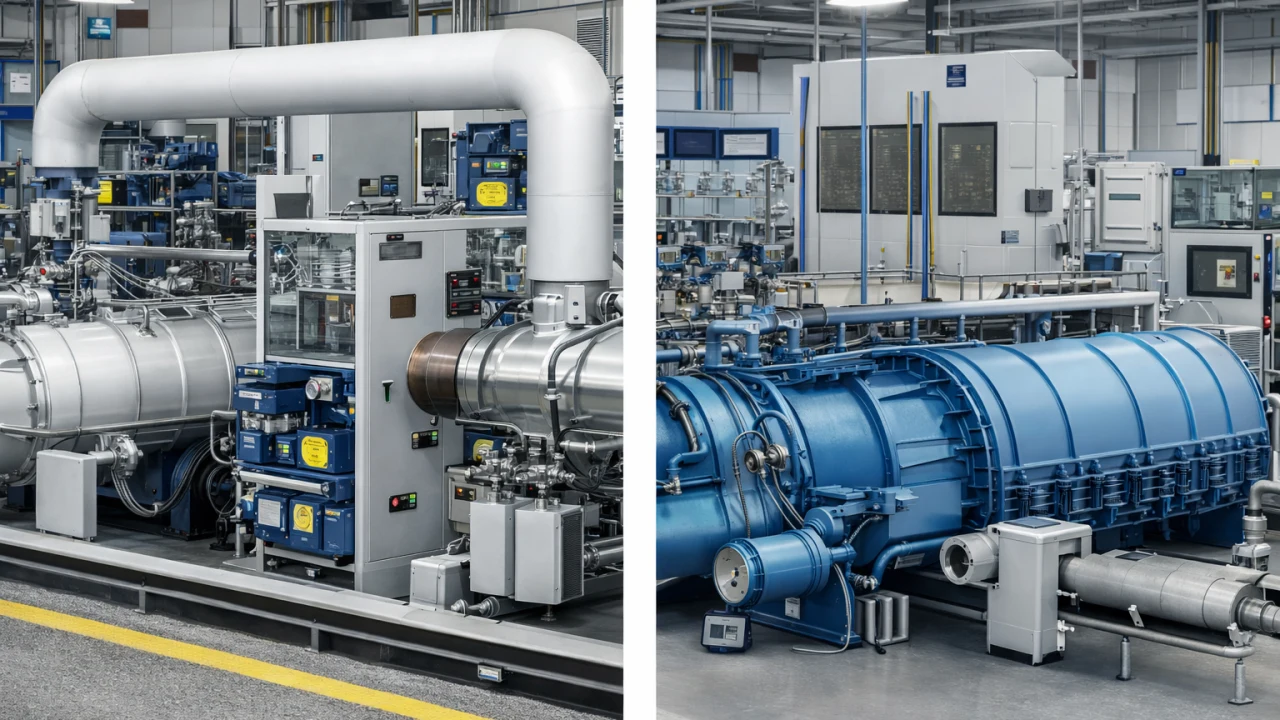
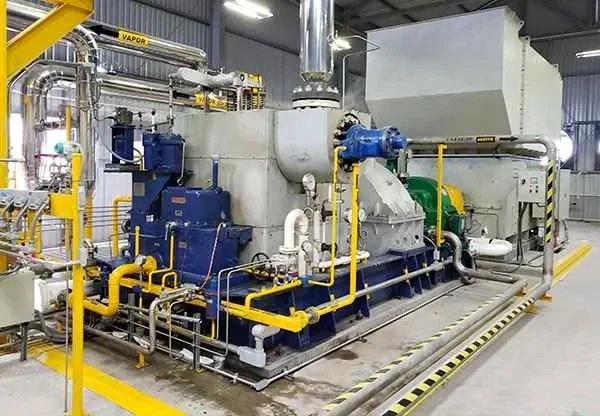
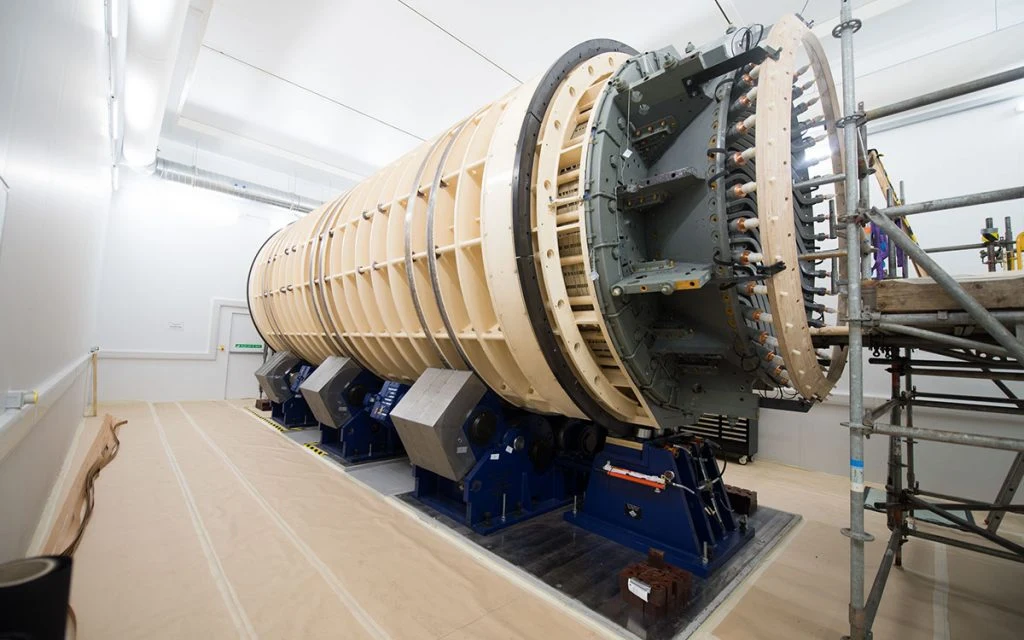
Large turbogenerators remain a central technology in conventional thermal power generation. Driven by steam turbines or combustion gas turbines, these synchronous machines convert the mechanical power of a rotating shaft into electrical power for transmission networks and industrial users. Their contribution extends beyond energy production: when connected and operated as synchronous machines, they can also support grid voltage, contribute fault current and provide rotating inertia.
The machines are engineered to operate under demanding mechanical, thermal and electromagnetic conditions. Their rotors run at high speed, their stator windings carry large currents, and their insulation systems must withstand electrical stress and temperature over long service periods. Large-unit ratings vary widely with design, cooling arrangement, speed, voltage, power factor and the capability of the complete turbine-generator train. Therefore, a figure such as 800 MW or 1,000 MW should be treated as an example of the scale achievable in some installations—not as a universal or routine rating for every turbogenerator.
Historically, many thermal units were designed primarily for steady baseload duty. The power system is now changing. Increasing shares of wind and solar generation, changing demand patterns, energy storage and new large electricity users are altering how thermal plants are dispatched. Where thermal units are required to provide flexibility, the turbine, generator, boiler or heat-recovery system, auxiliaries, controls and grid connection must be considered as one coordinated plant. The turbogenerator is an important part of that response, but it does not determine plant flexibility on its own.
How turbogenerator technology has evolved
The development of large turbogenerators has followed advances in metallurgy, electrical insulation, cooling, manufacturing, rotor dynamics and protection. As steam conditions and unit outputs increased, designers needed stronger rotor materials, improved stator-core construction, more capable winding insulation and more effective heat removal. Better balancing, bearing technology and vibration monitoring also helped engineers manage the mechanical demands of high-speed operation.
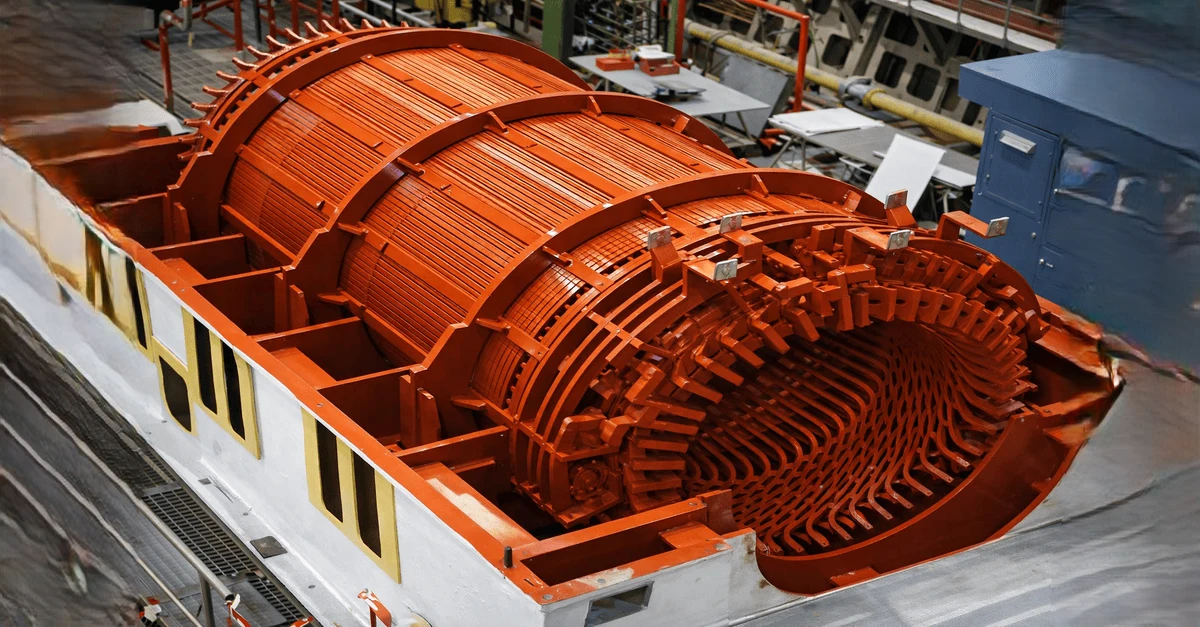
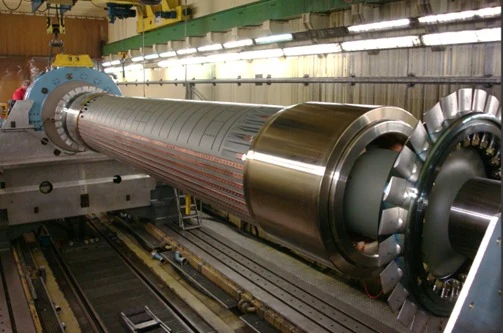
Modern large machines may use forged alloy-steel rotors, laminated electrical-steel stator cores, high-performance winding insulation and sophisticated cooling arrangements. Depending on rating and design, cooling may use air, hydrogen, water or combinations of these media. Hydrogen cooling is used in many large generators because hydrogen has favourable heat-transfer and windage characteristics, while direct water cooling may be used for selected stator or rotor winding designs. The actual arrangement is machine-specific and must follow the manufacturer’s design and operating instructions.
Key engineering developments include:
- High-strength forged rotor steels and carefully controlled manufacturing processes to withstand centrifugal and cyclic mechanical stresses.
- Improved stator and rotor insulation systems designed for electrical, thermal, mechanical and environmental endurance.
- Laminated stator cores that limit circulating eddy currents and associated core losses.
- Air, hydrogen and liquid cooling technologies selected to meet the thermal limits of the machine.
- Static excitation, digital protection and coordinated control systems that improve controllability and fault response.
- Condition-monitoring systems that help maintenance teams identify developing mechanical, electrical and thermal problems.
Why operating flexibility is becoming more important
As variable renewable generation increases, thermal plants in some power systems are asked to change output more frequently, operate at reduced load for extended periods, start and stop more often, or respond to changing reserve and voltage-support requirements. The extent of this duty depends on the electricity market, system operator instructions, plant design, fuel and steam-cycle constraints, environmental requirements and the condition of the equipment.
The Central Electricity Authority of India’s guidance on flexible operation of thermal plants emphasizes plant-level assessment, operational preparation, maintenance planning and consultation with original equipment manufacturers. This is an important distinction: a generator cannot simply be assumed to ramp at any rate or operate indefinitely at any minimum load. The allowable operating envelope is established by the complete unit design and its validated operating procedures.
For the generator itself, more frequent load changes and starts can influence thermal gradients, winding temperatures, rotor stresses, insulation ageing, shaft vibration and the condition of bearings and seals. Repeated changes in active and reactive power can also affect electrical and thermal loading. Engineers therefore need to assess the machine’s capability curves, permissible temperature limits, excitation-system response, cooling-system performance and protection settings under the intended operating profile.
A flexible operating strategy should be based on OEM limits, plant tests, condition assessments and grid-code obligations. It should not rely on generic ramp-rate or minimum-load values copied from another unit.
Efficiency and power density: improving performance without compromising life
Efficiency remains a major design and operating objective. Reducing electrical and mechanical losses can lower the energy required to deliver a given electrical output. At plant level, improvements in turbine-cycle performance, boiler or heat-recovery performance, auxiliary consumption and generator efficiency all influence the overall heat rate and emissions per unit of electricity.
Generator losses include stator and rotor copper losses, core losses, stray-load losses, friction and windage losses, and losses in auxiliary equipment. Design measures such as optimized magnetic circuits, suitable conductor cross-sections, improved ventilation or coolant flow, and high-quality manufacturing can help manage these losses. However, efficiency improvements must be evaluated alongside temperature rise, insulation life, mechanical strength, maintainability and operating flexibility.
Higher power density is not achieved simply by increasing current or magnetic loading. It requires coordinated electromagnetic, thermal, mechanical and insulation design. Cooling capacity, hot-spot temperatures, end-winding support, rotor stress, vibration behaviour and manufacturing tolerances all impose limits. Advanced coatings, improved impregnation processes and new materials may offer benefits in selected applications, but their performance must be demonstrated and qualified for the specific service environment.
Digitalization, condition monitoring and predictive maintenance
Digital monitoring is increasingly important in the operation and maintenance of large turbogenerators. Depending on the machine and plant instrumentation, monitored parameters can include bearing and shaft vibration, winding and coolant temperatures, hydrogen pressure and purity where applicable, seal-oil conditions, partial-discharge indicators, air-gap flux, excitation variables and electrical operating quantities.
The value of monitoring comes from interpreting trends in the context of operating conditions. A temperature or vibration reading rarely tells the whole story on its own. Baselines, sensor quality, load, coolant conditions, alarm thresholds and machine-specific limits all matter. Combining operational data with inspection findings and maintenance history can help identify abnormal trends earlier and support better-informed maintenance planning.
Predictive analytics and machine-learning tools can assist with anomaly detection, trend analysis and remaining-life estimation. They should be treated as decision-support tools, not as substitutes for protection systems, engineering judgement or approved operating procedures. A digital twin—a model linked to machine or plant data—may help evaluate scenarios, but its usefulness depends on model validation, data quality and the accuracy of its assumptions.
A practical digital strategy therefore starts with reliable instrumentation, disciplined data management, clear alarm rationalization, cybersecurity controls and integration with the plant’s maintenance and control systems. Advanced analytics can then be introduced where they provide measurable operational value.
Grid support: inertia, voltage and electrical capability
A grid-connected synchronous turbogenerator can contribute several services, subject to its design, operating point, excitation system, protection settings and network conditions. The rotating mass stores kinetic energy and contributes to the inertia of the interconnected system. The excitation system controls field current and enables the generator to regulate reactive-power exchange and terminal voltage within its capability limits. Synchronous machines can also contribute fault current, which may support protection and system-strength requirements.
These capabilities are not unlimited. The generator operates within a capability curve that defines permissible combinations of active power, reactive power, voltage and temperature. Reactive-power output can be constrained by stator current, rotor field current, end-region heating and stability limits. Fault-current contribution depends on machine reactances, excitation response and the transient behaviour of the system.
As inverter-connected renewable resources and battery systems become more prevalent, grid stability increasingly depends on a mix of synchronous machines, power-electronic controls, storage and network solutions. Large turbogenerators remain one part of this evolving mix. Their contribution should be evaluated using system studies rather than assumed to solve every stability challenge.
Safety engineering and hydrogen-cooled machines
Safety is fundamental to turbogenerator design, operation and maintenance. A large rotating machine contains substantial kinetic energy and operates with high electrical energy, hot surfaces, pressurized cooling circuits and heavy lifting requirements. Safety systems may include overspeed protection, vibration trips, differential and earth-fault protection, temperature monitoring, fire detection and suppression, and interlocks associated with auxiliary systems.
For hydrogen-cooled generators, gas handling requires specific controls because hydrogen can form flammable mixtures with air. The machine casing, seals, gas supply and drying systems, ventilation, gas detection, purging arrangements and operating procedures must be designed and maintained for the particular installation. Hydrogen-air displacement and maintenance entry must follow the OEM procedure and applicable safety requirements; generic instructions are not a substitute for site-approved procedures.
IEC 60034-3:2020 sets specific requirements for large three-phase synchronous generators driven by steam turbines or combustion gas turbines, including requirements and precautions for air-, hydrogen- and liquid-cooled machines. It states that the manufacturer must specify the hydrogen pressure and purity associated with rated output. Operators should therefore use the generator nameplate, technical documentation and approved operating instructions rather than applying a generic pressure value to all machines.
Future pathways: hybrid plants and lower-carbon operation
Thermal power plants are likely to operate alongside a broader portfolio of generation and flexibility resources. Hybrid configurations may combine thermal generation with solar or wind power, battery energy storage, pumped storage, thermal energy storage or other dispatchable resources. In such arrangements, the turbogenerator continues to convert shaft power into electricity, while plant controls and grid coordination determine how the unit participates in dispatch and system support.
Fuel and emissions strategies are also evolving. Gas turbines may be evaluated for hydrogen blending or other lower-carbon fuels, while some steam-cycle plants may consider biomass co-firing or other fuel changes. These options are not interchangeable and do not automatically make electricity carbon-free. Fuel composition, combustion behaviour, emissions, materials compatibility, efficiency, supply-chain emissions and retrofit requirements must all be assessed for the specific plant.
Advanced materials and manufacturing methods—including improved alloys, ceramic-matrix composites in selected high-temperature applications, additive manufacturing and engineered cooling passages—may influence future turbine and generator systems. Their use depends on qualification, fatigue and creep performance, inspection methods, repairability, cost and long-term service evidence. Some innovations are already used in particular applications; others remain under development or are limited to specialized components.
Autonomous and AI-assisted operation is another area of development. Data-driven systems may help optimize dispatch, identify abnormal conditions and recommend maintenance actions. Critical protection and safety functions, however, must remain governed by validated engineering designs, deterministic protection logic where required, cybersecurity controls and clear human accountability.
Engineering challenges that will shape the next generation
The transition to more flexible operation creates a demanding balance between performance, durability, safety and cost. More frequent cycling can increase thermal and mechanical fatigue. Low-load operation may introduce operating constraints elsewhere in the steam or gas-turbine cycle. Insulation systems continue to age under combined electrical, thermal, mechanical and environmental stress. Hydrogen systems require disciplined gas management, while large components create logistical challenges during transport, installation and major overhaul.
Decarbonization requirements add another layer. Operators and owners must consider emissions performance, fuel availability, water use, lifecycle impacts, retrofit feasibility and the remaining economic life of existing assets. A technically possible modification is not automatically the best commercial or environmental choice. Decisions should be based on whole-plant assessments and realistic operating scenarios.
Conclusion: a more connected and adaptable role
Large turbogenerators are not simply legacy components of the power system. They are mature, highly engineered machines whose synchronous operation can continue to provide valuable energy conversion and grid-support capabilities. Their future role will depend on how effectively they are integrated with flexible plant operation, digital monitoring, modern protection, storage and renewable generation.
The next generation of turbogenerator performance will not come from a single breakthrough. It will result from coordinated improvements in materials, cooling, electromagnetic design, manufacturing quality, condition monitoring, maintenance practices and system-level control. Above all, flexibility must be achieved within verified equipment limits and without compromising safety or service life. In an evolving electricity system, the enduring value of large turbogenerators will be measured not only by the megawatts they produce, but also by the reliability and support they can deliver when the grid needs them.
A closer look
Explore the key principles
Select a topic below to see its role in the complete system.
Flexible duty
Starts, reduced-load operation and load changes alter the thermal and mechanical duty of the unit.
Digital monitoring
Reliable sensors, baselines and validated models support maintenance decisions.
Grid support
Synchronous machines provide inertia and voltage support within electrical and thermal limits.
Common questions
Can any existing machine adopt faster ramp rates?
No. The turbine, generator, heat source, controls and auxiliaries need a coordinated assessment.
Can predictive analytics replace protection?
No. Analytics support decisions; engineered protection and approved operating limits remain essential.
Further reading
Technical background for the principles discussed. Equipment-specific instructions take precedence.
Discuss your equipment requirements
Share the equipment details, operating concerns and available inspection records with our team.