The essentials
Key takeaways
- State whether the boundary is the generator, gross plant or net plant.
- Losses and efficiency vary with operating conditions.
- A percentage-point change is different from a relative percentage change.
Introduction: The Silent Variable in Power Plant Performance
In power plant engineering, discussions about efficiency almost always revolve around thermodynamic cycles, turbine blade design, combustion improvement, or advanced boiler systems. Engineers debate heat rate reduction, steam parameters, supercritical technology, and combined cycle configurations.
Yet, one of the most critical components in the energy conversion chain often receives minimal optimization attention -the generator.
Large generators can have very high rated efficiencies, but the actual value depends on the design, rating and test boundary. Nameplate performance alone does not describe losses across a changing operating profile.
In reality:
- Small efficiency variations translate into massive fuel cost differences.
- Partial-load operation significantly alters actual performance.
- Cooling systems and auxiliary losses are under-accounted.
- Harmonics and grid instability impact real-world efficiency.
- Environmental implications of marginal inefficiencies are substantial.
As global electricity demand rises and decarbonization accelerates, generator efficiency is no longer a background metric -it is a strategic engineering parameter.
This article explores what engineers often ignore about generator efficiency -technically, economically, environmentally, and globally.
Understanding Generator Efficiency: Beyond the Textbook Definition
Generator efficiency is mathematically defined as:
Efficiency (η) = Electrical Output Power / Mechanical Input Power
While this formula is simple, real-world efficiency is influenced by multiple internal loss mechanisms:
Major Loss Categories
- Stator copper losses (I²R): resistive heating in the stator windings.
- Rotor copper losses: resistive heating associated with field current.
Core Losses
- Hysteresis loss
- Eddy current loss
- Stray-load losses: additional losses associated with load-dependent magnetic fields and current distribution.
- Windage and friction losses: mechanical losses associated with gas drag and bearings.
- Auxiliary energy: account separately for external cooling and excitation loads according to the chosen measurement boundary.
When engineers evaluate generator performance, they often focus only on terminal efficiency at rated load. However, actual plant conditions differ significantly from design assumptions.
The Partial Load Reality: Where Efficiency Is Lost
The efficiency curve depends on machine design and operating conditions. The best operating point is not necessarily full load.
Due to:
- Renewable energy integration
- Grid demand fluctuation
- Maintenance schedules
- Regulatory dispatch control
The actual load profile must be established from operating records rather than assumed from a generic range.
At partial loads:
- Some core and mechanical losses are less load-dependent when speed and voltage remain comparable.
- Output power decreases.
- Losses become a different fraction of output as load changes.
A generator’s efficiency generally changes with load because some losses vary with current while other losses are less load-dependent. However, there is no universal part-load efficiency value: a generator rated at 97% at full load cannot automatically be assumed to fall to 93–95% at a particular part load. The actual efficiency curve must come from the manufacturer’s guaranteed data or a properly conducted performance test, with operating voltage, power factor, cooling conditions and auxiliary loads stated.
For a large plant, a change in generator losses can affect shaft-power demand and, depending on the prime mover, fuel use. Quantify the change at a consistent boundary.
- Higher shaft-power requirement at the same electrical output
- Increased CO₂ emissions
- Possible changes in auxiliary demand, depending on the operating conditions
- Changes in heat rejected by the generator
Yet many engineers analyze efficiency based only on rated conditions, ignoring real operational data.
Cooling Systems: The Hidden Energy Consumers
Large generators use different cooling methods:
- Air cooling
- Hydrogen cooling
- Water cooling
Hydrogen-cooled generators require additional supporting systems, which may include:
- Sealing systems
- Gas purification units
- Gas supply and handling equipment as specified by the design
- Monitoring systems
- Account for external auxiliary energy explicitly when assessing net plant performance.
Similarly, water-cooled stator systems require:
- Pumping power
- Heat exchangers
- Cooling tower integration
When these auxiliary demands are not included in efficiency calculations, generator performance appears better than actual delivered efficiency.
A system-level analysis must include auxiliary power consumption associated with the generator.
Harmonics and Power Quality: The Overlooked Electrical Reality
Modern power grids experience:
- Harmonic distortion
- Reactive power imbalances
- Voltage instability
Inverter-connected equipment and other non-linear loads can contribute harmonics. Actual distortion depends on controls, filters and network conditions.
Harmonics cause:
- Increased copper heating
- Stray load losses
- Additional frequency-dependent magnetic losses
- Reduced insulation life
Despite these measurable impacts, many plants do not factor harmonic-related losses into efficiency evaluations.
Efficiency must be analysed dynamically, including grid-induced electrical disturbances.
Power Factor and Reactive Power Management
Generator efficiency is often measured in terms of active power output. However, power factor plays a critical role.
At a fixed active-power output and terminal voltage, reducing the magnitude of power factor:
- Increases stator current
- Raises I²R losses
- Causes temperature rise
- Changes the thermal duty of the winding and insulation system
Generators providing reactive power support (voltage stability services) may operate below optimal power factor conditions, decreasing effective efficiency.
Reactive-power requirements must be met within the generator capability curve, even when this differs from the lowest-loss operating point.
This trade-off is rarely highlighted in performance discussions.
Mechanical Factors That Reduce Efficiency Over Time
Over years of operation, mechanical factors degrade performance:
- Shaft misalignment
- Bearing wear
- Increased friction
- Rotor imbalance
- Thermal expansion distortion
- Even minor increases in friction reduce mechanical-to-electrical conversion efficiency.
Trending vibration, oil condition and alignment findings can help identify mechanical degradation. Any efficiency benefit should be measured rather than assumed.
Generator Efficiency and Overall Plant Heat Rate
The true measure of plant performance is heat rate:
Plant heat rate = fuel energy input ÷ net electrical energy output, when calculated on a clearly stated plant boundary and fuel heating-value basis (LHV or HHV). Generator efficiency is a separate conversion metric: electrical output at the generator terminals divided by mechanical input at the shaft. Gross versus net output and generator auxiliaries must be treated consistently.
If generator efficiency decreases:
- More fuel is required for the same electrical output.
- Heat rate worsens.
- Emissions rise.
- Operational cost increases.
Many plant performance audits focus on turbine heat balance while assuming constant generator efficiency.
However, slight electrical losses distort total heat rate measurements and create inaccurate optimization models.
Economic Impact of Small Efficiency Improvements
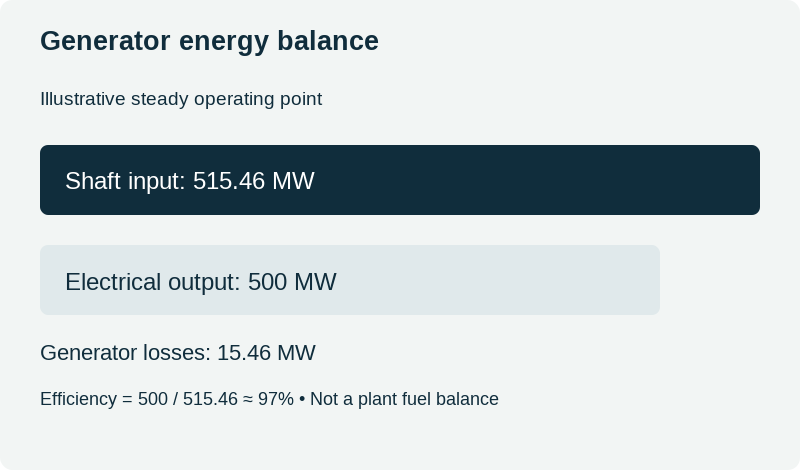
Consider an illustrative generator delivering a constant 500 MW of electrical output.
A change in efficiency must be defined carefully. A reduction from 97% to 96% is a decrease of one percentage point, not a 1% relative decrease. For a generator delivering a constant 500 MW of electrical output, the mechanical input and generator losses are:
- At 97% efficiency: mechanical input = 500 MW ÷ 0.97 = 515.46 MW; generator losses = 515.46 − 500 = 15.46 MW. At 96% efficiency: mechanical input = 500 MW ÷ 0.96 = 520.83 MW; generator losses = 520.83 − 500 = 20.83 MW. The difference is approximately 5.37 MW of additional mechanical input at the same 500 MW electrical output. This is not automatically 5.37 MW of fuel input; the corresponding fuel-energy change depends on the prime mover and plant heat rate.
- If this same operating point persisted for 7,446 equivalent hours, the additional mechanical energy would be about 40 GWh. This is an illustrative shaft-energy comparison, not a fuel-mass or emissions estimate; varying-load operation requires integration over the actual duty profile.
- Fuel cost requires a separate plant heat-rate calculation.
- Emissions depend on fuel and combustion controls.
- Maintenance effects depend on the cause of the increased losses.
The commercial significance depends on energy prices, operating hours, upgrade cost and outage requirements.
Generator efficiency directly influences:
- Operating cost per kWh
- Tariff competitiveness
- Long-term asset viability
- Return on investment (ROI)
Environmental Consequences of Generator Inefficiency
Generator inefficiency contributes to:
Increased Carbon Emissions
More fuel consumption means higher CO₂ emissions per kWh.
Higher NOx, SOx, and Particulate Emissions
The effect on pollutants depends on the fuel, combustion conditions and installed emissions controls.
Increased Water Usage
Cooling-water demand depends on heat rejection and the plant cooling arrangement.
Resource Depletion
- More mining, transportation, and logistics required.
- Even marginal improvements contribute meaningfully to decarbonization goals.
Compare efficiency projects using measured losses, lifecycle cost and the relevant environmental boundary.
Global Significance in the Energy Transition Era
Global electricity demand continues rising due to:
- Electrification of transport
- Industrial growth
- Data center expansion
- Urbanization
Simultaneously, countries are committed to:
- Net Zero targets
- Carbon pricing
- ESG compliance
- Sustainable energy transitions
High generator efficiency supports:
- Reduced import dependency
- Improved national energy security
- Lower energy intensity
- Enhanced grid resilience
Fleet-level savings must be calculated from the actual machines, operating profile and achievable improvement.
Material Science and Design Evolution
Modern generator performance improvements rely on:
Advanced Core Materials
- Electrical steel selected for the machine’s magnetic circuit
- Lower hysteresis laminations
- Reduced eddy current designs
High-Conductivity Copper Windings
- Improved resistance properties
- Enhanced thermal stability
Insulation Technology
- High thermal class insulation
- Reduced dielectric loss
- Material changes require coordinated electromagnetic, thermal and mechanical assessment.
- However, cost considerations often delay upgrades.
Lifecycle analysis determines whether an upgrade justifies its initial cost and outage.
Digital Monitoring and Smart Generator Analytics
Industry 4.0 has transformed power plant monitoring.
Advanced plants now use:
- IoT-based temperature sensors
- Partial discharge monitoring
- Real-time loss mapping
- AI-driven anomaly detection
- Digital twin simulation
Validated digital models can support investigation of:
- Efficiency degradation
- Insulation condition trends
- Harmonic distortion
- Thermal hotspots
Monitoring supports performance analysis when sensor quality, baselines and model assumptions are controlled.
The Role of AI and Smart Grid Interaction
Future power systems may include more:
- Renewable-dominant
- Decentralized
- Digitally controlled
Generators must operate dynamically, responding to:
- Rapid frequency fluctuations
- Solar variability
- Wind intermittency
- Storage dispatch changes
Validated analytics can support excitation and load-sharing decisions within approved capability and protection limits.
Dynamic monitoring complements formal performance testing.
Superconducting and Next-Generation Generators
Research in superconducting generators shows potential for:
- Reduced copper losses
- Higher magnetic flux density
- Smaller physical size
- Potential efficiency improvements, subject to cryogenic and system losses
Challenges include:
- Cryogenic cooling systems
- Cost constraints
- Grid adaptation
These concepts require application-specific validation and are not universal commercial solutions for large turbogenerators.

Lifecycle Perspective: From Installation to Decommissioning
Generator efficiency impacts every stage of asset lifecycle:
- Design optimization
- Installation quality
- Commissioning alignment
- Operational monitoring
- Maintenance planning
- Retrofit upgrades
- End-of-life recycling
- A lifecycle efficiency mindset ensures sustained performance rather than peak-only performance.
Why Engineers Often Ignore Generator Efficiency
- Efficiency already appears high.
- Turbine improvements offer larger percentage gains.
- Losses seem minimal individually.
- Responsibility is split across departments.
- Real-time measurement complexity discourages analysis.
- However, small, overlooked losses accumulate into significant economic and environmental impacts.
Strategic Recommendations for Engineers
- Map efficiency across full load spectrum.
- Include auxiliary losses in calculations.
- Monitor harmonics continuously.
- Optimize reactive power management.
- Integrate generator performance in digital dashboards.
- Conduct periodic loss segregation audits.
- Align generator efficiency targets with sustainability KPIs.
Advantages of High Generator Efficiency
Small reductions in losses can accumulate over long operating periods. Their financial and environmental value must be calculated for the actual plant, rather than inferred from a generic percentage.
. Reduced Fuel Consumption
At a fixed electrical output, reducing generator losses lowers the required shaft input. The fuel benefit then depends on the prime mover and plant boundary.
- Lower heat rate (kJ/kWh or BTU/kWh)
- Improved thermal plant performance
- Auxiliary demand must be evaluated separately.
- This contributes to better plant-level energy performance indicators (EPIs).
. Lower Greenhouse Gas Emissions
High generator efficiency reduces overall fuel burn, which directly lowers:
- CO₂ emissions
- NOx and SOx emissions
- Particulate matter
- Emissions savings require a plant-specific fuel and operating model.
. Improved Operational Reliability
Efficient generators produce less heat under load due to reduced resistive losses. This results in:
- Lower winding temperatures
- Reduced insulation degradation
- Extended equipment lifespan
- Fewer forced outages
Lower losses can reduce heat rejection, but thermal cycling also depends on the dispatch profile and cooling response.
. Economic Benefits
From a financial standpoint, efficient generators offer:
- Lower lifecycle operating cost (LCOE improvement)
- Reduced maintenance frequency
- Better ROI on capital investment
- Increased plant competitiveness in deregulated energy markets
Dispatch decisions also depend on fuel prices, unit constraints and market rules.
. Grid Stability and Performance
Generator efficiency and grid-support capability are separate characteristics. Voltage control and reactive-power capability must be evaluated on their own terms.
Disadvantages of Focusing on Generator Efficiency
While high generator efficiency offers many benefits, excessive focus on maximizing efficiency can introduce engineering trade-offs and operational complexities.
. High Capital Cost
Advanced materials such as:
- High-grade silicon steel
- Advanced copper windings
- Hydrogen cooling systems
- Application-specific magnetic and insulation materials
increase capital expenditure. Upfront cost may not justify marginal efficiency gains in smaller plants.
. Diminishing Returns
Where a design already has low losses, further improvements may require substantial investment for a modest energy benefit.
- Engineering complexity increases
- Marginal economic return declines
- Cost-to-benefit ratio decreases
- This creates a practical economic limit.
. Complex Cooling Systems
Cooling systems appropriate to large turbogenerator designs include:
- Hydrogen cooling
- Water-cooled stator bars
- Air cooling with the specified heat-exchanger arrangement
These systems improve performance but introduce operational risks, including hydrogen leakage hazards and increased maintenance complexity.
. Sensitivity to Operating Conditions
- Part-load behaviour must be assessed from the specific machine’s efficiency curve.
- The fraction of output represented by losses changes with load.
- Vibration depends on machine condition and operating point.
- Power quality depends on the electrical system and controls.
- This becomes critical in grids with fluctuating renewable integration.
. Over-Optimization Risk
Designing solely for maximum efficiency may compromise:
- Mechanical robustness
- Fault tolerance
- Maintenance accessibility
In some cases, slightly lower efficiency with higher durability is operationally more practical.
Limitations of Generator Efficiency Improvements
Despite technological advancements, generator efficiency improvements face several physical, material, economic, and operational constraints.
. Physical and Thermodynamic Limits
No generator can achieve 100% efficiency due to fundamental physical losses:
- Copper losses (I²R losses)
- Core losses (hysteresis and eddy currents)
- Mechanical friction
- Windage losses
- Electromagnetic theory and material resistivity impose unavoidable efficiency limits.
. Material Science Constraints
The efficiency of generators depends heavily on materials. However:
- Magnetic core materials have saturation limits
- Insulation systems degrade under thermal stress
- Conductor resistance cannot be eliminated entirely
- Material improvements require significant R&D investment and rare resources.
. Economic Viability
From a power plant management perspective:
- Investment must align with payback period
- Efficiency upgrades must justify shutdown time
- Retrofitting older plants may not be feasible
Often, upgrading turbines or boilers offers better ROI compared to generator upgrades.
. Operational Load Variability
Modern grids incorporate renewable energy sources such as solar and wind. Load variability affects generator efficiency because:
- Efficiency varies across the operating range.
- Part-load performance must be measured or modelled at matched conditions.
- Frequent ramping increases mechanical stress
- Thus, theoretical efficiency may not reflect real operational efficiency.
. Environmental and Infrastructure Constraints
Hydrogen cooling improves generator efficiency but introduces safety risks and environmental management challenges. Additionally:
- Cooling water availability may limit efficiency upgrades
- Infrastructure modifications may be expensive
- Grid constraints may restrict optimal operating conditions
. Aging Power Plants
- Ageing machines require condition assessment before efficiency improvements are specified.
- Insulation condition may constrain the scope of an upgrade.
- Winding resistance increases
- Mechanical wear affects performance
- Retrofitting may not fully restore design efficiency.
A Shift in Engineering Perspective
Generator efficiency is not merely a specification sheet parameter -it is a dynamic performance driver influencing cost, sustainability, and reliability.
As global power systems evolve toward:
- Smart grids
- Renewable integration
- Carbon neutrality
- Digitalization
- Generator optimization becomes critical.
Engineers who rethink generator efficiency beyond rated load assumptions will unlock:
- Operational cost savings
- Environmental gains
- Improved asset longevity
- Enhanced grid stability
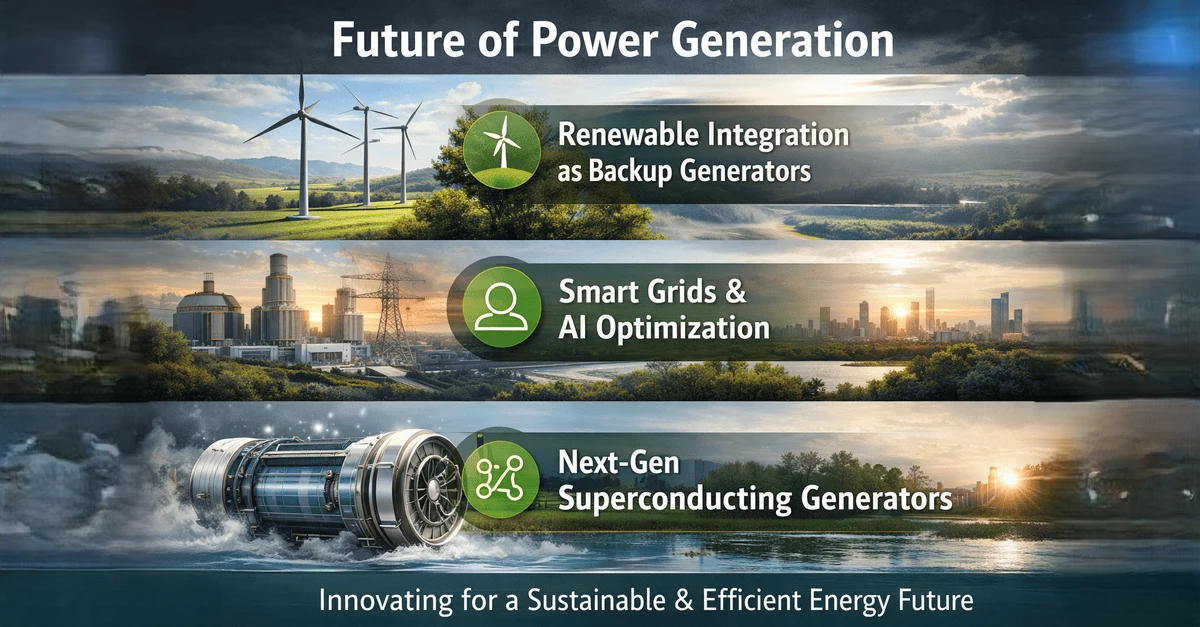
The future of power generation demands a systems-level mindset -where generator efficiency is recognized not as a fixed number, but as a continuously optimized engineering frontier.
A closer look
Explore the energy balance
Select a topic below to see its role in the complete system.
Shaft input
At 500 MW electrical output and 97% efficiency, shaft input is 500 ÷ 0.97 = 515.46 MW.
Generator losses
At that operating point, losses are 515.46 − 500 = 15.46 MW. This is an illustrative balance.
Plant boundary
Fuel energy and external auxiliary consumption need a separate plant-level calculation.
Common questions
Is generator efficiency the same as plant efficiency?
No. Generator efficiency compares electrical output with shaft input. Plant efficiency compares delivered electricity with the energy supplied to the plant.
Does a 1% change always mean one percentage point?
No. A move from 97% to 96% is one percentage point, or about a 1.03% relative decrease.
Further reading
Technical background for the principles discussed. Equipment-specific instructions take precedence.
Discuss your equipment requirements
Share the equipment details, operating concerns and available inspection records with our team.