The essentials
Key takeaways
- Restricted expansion and temperature gradients produce thermal stress.
- Generator thermal limits differ from steam-side temperatures.
- Duty history, cooling and component condition guide assessment.
Overview
Thermal plants use steam turbines, gas turbines or combined cycles to drive generators. The turbine and generator share a shaft train but experience different heat sources and temperature limits.
Although thermally efficient and technologically mature, this process exposes turbines, generators, and associated systems to extreme temperature variations. One of the most critical mechanical and structural challenges affecting performance, reliability, and lifecycle cost is thermal stress in generator components.
Temperature gradients and differential expansion can affect rotor stability, winding support and insulation. High-temperature creep is mainly a concern for hot turbine and steam-side components, and should not be treated as a universal generator failure mechanism.
Fundamentals of Thermal Stress in Power Generation Equipment
Definition of Thermal Stress
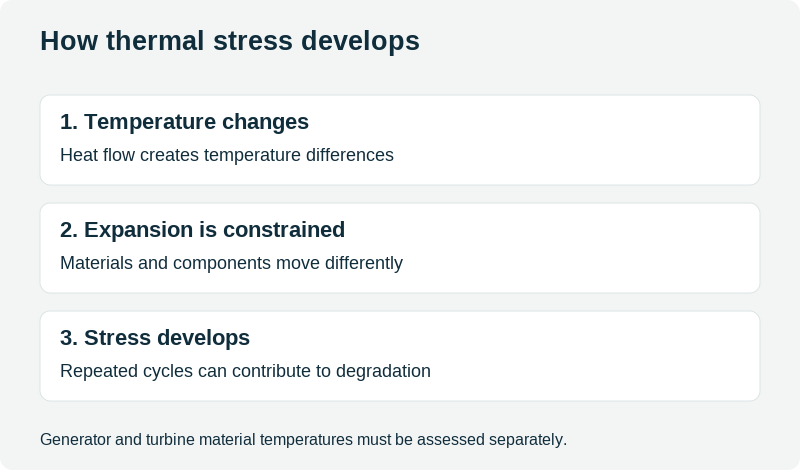
Thermal stress refers to internal mechanical stresses that arise within a material due to temperature change when expansion or contraction is restricted. When a component is heated, it expands; when cooled, it contracts. If this dimensional change is constrained by geometric configuration or adjacent structures, internal stress develops.
In large power generators, constraints arise from:
- Structural rigidity
- Coupling with other rotating components
- Bearing supports
- Composite material interfaces
Thermal Gradients in Large Rotating Machinery
Generator rotors and shafts often have large diameters. During heating:
- Surface temperature rises quickly.
- The interior responds more slowly because heat transfer takes time.
- Radial thermal gradients develop.
The outer layers attempt to expand more rapidly than the inner core, creating compressive and tensile stress distributions across the cross-section.
Primary Sources of Thermal Stress in Thermal Power Plant Generators
Startup and Shutdown Cycles
Startup and shutdown can create significant transient temperature gradients.
For steam-side turbine components, startup may involve:
- Steam temperature increases rapidly.
- Turbine casing heats unevenly.
- Rotor surface temperature increases faster than the interior.
- Differential expansion occurs.
This creates:
- Surface compressive stress
- Internal tensile stress
- Transient distortion
During shutdown:
- Cooling creates its own transient temperature gradients.
- Reverse gradients form.
- Cyclic stress accumulation occurs.
More frequent cycling can increase fatigue exposure, depending on the operating profile and equipment design.
Load Fluctuations and Grid Instability
Modern power grids require ramping capability to balance solar and wind fluctuations.
A change in electrical load changes stator current and the generator operating point. The resulting heating depends on active power, reactive power, terminal voltage, power factor, cooling conditions and the generator capability curve; excitation current is controlled primarily to meet voltage and reactive-power requirements, and does not simply rise in direct proportion to active load. Load changes can cause:
- Changes in excitation current, depending on reactive-power and voltage requirements
- Higher copper losses (I²R losses)
- Elevated stator temperature
Localized heating leads to non-uniform expansion in:
- Rotor forging
- Stator core laminations
- Retaining rings
- End windings
- These dynamic temperature variations induce repeated thermal stresses.
Material Expansion Mismatch
Generator construction incorporates multiple materials:
- Copper windings
- Silicon steel laminations
- Epoxy-mica insulation
- High-strength alloy steel shafts
Each material has a different thermal expansion coefficient. Under temperature rise:
- Copper expands more than steel.
- Insulation behaves differently from conductors.
- Shear stress develops at interfaces.
Repeated differential movement can contribute to cracks or delamination, depending on material properties and support conditions.
High-Temperature Operation in Advanced Plants
In ultra-supercritical steam power plants, main-steam and reheat-steam temperatures can exceed 600°C, depending on the plant design. These are steam-cycle operating temperatures, not normal generator winding or rotor temperatures. The generator operates within its own specified thermal limits, while the turbine, steam piping, valves and boiler pressure parts experience the high steam temperatures. Higher steam conditions increase the thermal-design and creep demands on those steam-side components.
Steam-side temperatures and generator temperatures must be assessed separately.
Thermal Stress Mechanisms
Thermo-Mechanical Fatigue (TMF)
TMF results from cyclic temperature variation combined with mechanical loading.
Damage sequence includes:
- Microstructural damage initiation
- Crack nucleation
- Stable crack growth
- Final fracture
TMF life is influenced by temperature range, ramp rate, and hold time.
Creep Deformation
Time-dependent creep is important at sufficiently high material temperatures under sustained stress. In a thermal plant it is particularly relevant to hot components such as:
- Turbine rotors
- High-pressure casings
- Superheater components
Creep progression includes:
- Primary creep (decelerating rate)
- Secondary creep (steady-state rate)
- Tertiary creep (accelerating to rupture)
- Creep and fatigue interactions accelerate damage.
Stress Relaxation
Stress relaxation and its interaction with cyclic loading depend on material, temperature and restraint. Assess the mechanism for the specific component.
Impact on Generator Components
Rotor Forging and Shaft Stability
The rotor experiences:
- Radial thermal gradients
- Centrifugal forces
- Electromagnetic torque
- Torsional stress
Thermal stress may cause:
- Rotor bowing
- Eccentric rotation
- Increased bearing load
- Shaft misalignment
- Vibration amplification
- Uncontrolled rotor distortion may result in forced shutdown.
Stator Core Laminations
Stator cores consist of laminated silicon steel to minimize eddy current losses.
Thermal stress can cause:
- Differential lamination expansion
- Loss of clamping pressure
- Core vibration
- Localized overheating
Damage to inter-lamination insulation or core integrity may increase local losses and heating.
Stator Windings and Insulation
Insulation life is highly temperature-sensitive.
Thermal and mechanical stresses can contribute to:
- Mechanical tension in insulation
- Crack formation
- Delamination
- Partial discharge activity
Insulation ageing depends on temperature history and the insulation system, together with moisture, contamination, vibration and electrical stress. Generic temperature-versus-life rules should not replace OEM limits or a qualified life assessment.
Retaining Rings and End Windings
Retaining rings restrain centrifugal forces in rotor windings.
Retaining rings and end-winding supports experience combined loads. Potential concerns depend on the material and environment and include:
- Cracking where susceptible materials, tensile stress and environmental conditions coincide
- Axial displacement
- Distortion
- Increased vibration amplitude
Failure Modes Due to Thermal Stress
Thermal stress contributes to:
- Low-cycle fatigue failure
- High-cycle fatigue under vibration
- Creep in components operating at sufficiently high material temperatures
- Crack propagation
- Rotor dynamic instability
The effect of repeated cycles on life depends on their severity and the component design.
Environmental Implications
Thermal stress has indirect yet significant environmental consequences.
Reduced Efficiency and Emissions Increase
Damage that increases generator losses can worsen fuel-to-electricity performance at a consistent plant boundary.
Higher heat rate results in:
- Increased fuel consumption
- Higher CO₂ emissions
- Pollutant changes governed by fuel and emissions controls
- Changes in heat rejection and auxiliary demand
Resource Consumption
Frequent component replacement requires:
- Steel production
- Copper mining
- Manufacturing energy
- This increases lifecycle environmental footprint.
Grid Reliability and Renewable Integration
Unexpected generator failures:
- May require replacement generation
- Can affect the reserve margin
- Require system-level assessment of dispatch consequences
- Therefore, thermal stress management supports climate goals indirectly.
Global Significance
Life-extension and cycling assessments are relevant wherever thermal units provide dispatchable generation.
- Review the actual duty history.
- Assess current component condition.
- Use validated operating limits.
As plants age beyond original design life, life-extension strategies require advanced stress evaluation.
Flexible grid demands further increase cyclic loading severity.
Engineering Mitigation Strategies
Controlled Ramp Rates
Optimized startup and shutdown procedures reduce steep temperature gradients.
Finite Element Analysis (FEA)
FEA models simulate:
- Transient thermal fields
- Stress concentration
- Creep-fatigue interaction where applicable to the material temperature
Advanced Cooling Systems
Modern generators use:
- Hydrogen gas cooling
- Direct water-cooled stator windings
- Improved airflow path design
- Enhanced heat removal reduces thermal gradient severity.
Online Monitoring and Predictive Maintenance
Monitoring systems measure:
- Rotor temperature
- Stator temperature
- Vibration levels
- Hydrogen purity
- Condition-based maintenance supports earlier investigation of developing faults.
Advanced Materials
Material advancements include:
- Qualified alloys for the relevant component and temperature
- Thermal barrier coatings for appropriate turbine hot-section applications
- Higher thermal class insulation systems
Future Engineering Outlook
Digital Twin Technology
Validated digital twins can help evaluate thermal scenarios; model quality and data coverage limit predictions.
Artificial Intelligence-Based Diagnostics
Analytics can flag abnormal patterns, but do not provide certain predictions of failure.
Flexible Operation Algorithms
Intelligent ramp rate management minimizes temperature gradient formation.
Low-Carbon Thermal Systems
Emerging technologies:
- Hydrogen combustion
- Carbon capture integration
- Supercritical CO₂ cycles
- have different thermal profiles and require technology-specific assessment.
Conclusion
Thermal stress arises from constrained expansion, temperature gradients and material mismatch. In generators it can affect rotor stability, winding support and insulation; hot turbine components require additional assessment of high-temperature mechanisms.
Its impact extends beyond mechanical reliability to influence:
- Operational efficiency
- Emissions intensity
- Maintenance cost
- Environmental sustainability
- Energy security
As thermal power continues to support global electricity demand—particularly in rapidly developing economies—advanced thermal stress monitoring, predictive modelling, improved materials, and smart operational strategies are essential.
Thermal stress management is not merely a maintenance concern; it is a strategic engineering priority essential for ensuring sustainable, reliable, and efficient power generation in the decades ahead.
A closer look
Explore thermal stress
Select a topic below to see its role in the complete system.
Temperature gradient
Different regions respond to heating and cooling at different rates.
Differential expansion
Materials and components expand differently; restraint can create internal stress.
Cyclic duty
Repeated thermal changes can contribute to fatigue and insulation degradation.
Common questions
Does 600°C steam mean the generator operates at 600°C?
No. The generator has separate heat sources, cooling and thermal limits.
Can a generic insulation-life rule predict a failure date?
No. Life depends on the insulation system and combined electrical, thermal, mechanical and environmental history.
Further reading
Technical background for the principles discussed. Equipment-specific instructions take precedence.
Discuss your equipment requirements
Share the equipment details, operating concerns and available inspection records with our team.