The essentials
Key takeaways
- Sliding contacts bridge stationary and rotating electrical circuits.
- Power, signal and environmental requirements determine selection.
- Contact condition and maintenance access matter throughout service life.
A connection that allows rotation
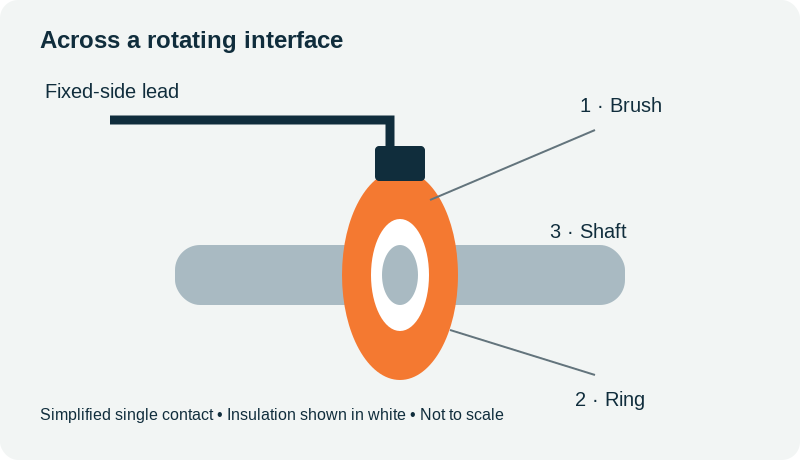
A conventional slip ring uses a conductive ring and a contacting brush to provide an electrical path across a rotating interface. The ring typically turns with the rotating assembly while the brush remains stationary. This arrangement allows relative motion without repeatedly winding a connecting cable around the shaft.
The contact is part of a complete circuit; the simplified illustration shows one interface. Practical assemblies may contain several electrically isolated channels for the required power or signal connections.
Where slip rings are useful
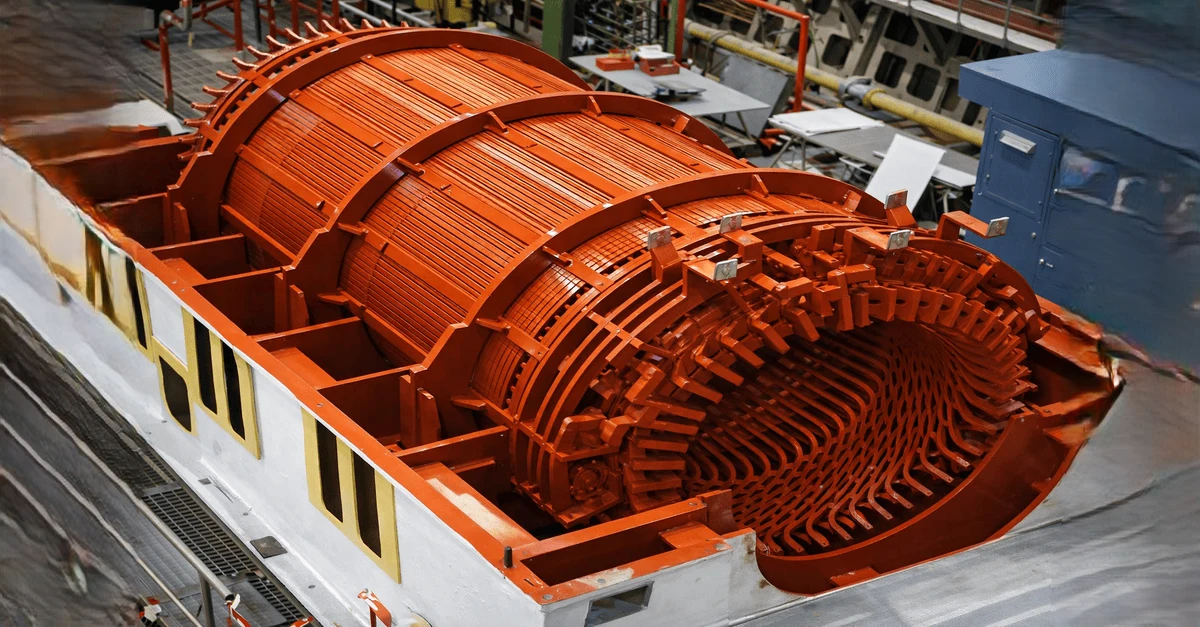
Slip rings are used where an electrical connection must cross an interface that rotates. Depending on the equipment design, applications include rotating industrial machinery, cranes, wind turbine systems and instrumentation.
The role depends on the machine design; not every turbine or generator uses slip rings. Identify which circuit crosses the rotating interface and what performance it requires.
Select for the actual duty
Prepare an application specification before comparing products. State the electrical requirements, number of channels, rotation requirements, available space and environmental conditions. Include signal requirements where relevant, rather than treating every connection as an interchangeable power circuit.
Discuss installation, access and maintenance expectations with the supplier. A suitable component is one that fits the complete application; a generic claim of higher quality does not establish compatibility.
Keep the interface serviceable
The brush and ring form a working contact, so their condition matters. Inspection and servicing should follow the assembly manufacturer’s instructions. Record changes in behaviour and use them to guide investigation rather than repeatedly replacing parts without understanding the cause.
JB Advanced Engineering Limited can help discuss slip-ring requirements and sourcing. Provide the equipment identification and available drawings or specifications when making an enquiry.
A closer look
Explore the slip-ring interface
Select a labelled component to understand its role in the diagram.
1 · Brush
The stationary contact slides against the ring. It connects the fixed-side circuit to the moving contact surface.
2 · Ring
The conductive ring rotates with the assembly while maintaining contact with the brush. Multiple channels require electrical separation.
3 · Shaft
The shaft provides rotation. The electrical path is through the intended conductors; the shaft is not shown as a circuit conductor.
Common questions
Can slip rings carry signals as well as power?
Yes, suitable assemblies can carry electrical signals. The product must be specified for the relevant signal and application requirements.
Are all slip rings interchangeable?
No. Electrical capacity, mechanical fit, operating environment and connection requirements must match the application.
Further reading
Technical background for the principles discussed. Equipment-specific instructions take precedence.
Discuss your equipment requirements
Share the equipment details, operating concerns and available inspection records with our team.